
India has built one of the largest school systems in the world and the numbers on access are impressive.. One sad lesson keeps showing up in the data. Enrolment does not automatically mean learning, which’s why the Annual Status of Education Report (ASER) moved the national conversation from schooling to what children can actually do. The 2020 National Education Policy (NEP) responded by reorganising schooling around a stage: two years of pre‑primary education entry into primary school at age six and basic reading and math by Grade 2 or 3. This is an idea because a child who cannot read fluently by eight struggles with every subject that follows.
The latest evidence shows progress. ASER 2024 surveyed 640,000 children in almost 18,000 rural villages and found an overall positive trend in foundational learning with some skills even higher than before the pandemic. The share of Class III children reading at a Class II level rose from 20.5% in 2022 to 27.1% in 2024. Class V reading improved from 42.8% to 48.8%. Government‑school Class III reading rose from 16.4% to 27.9% over the period. Analysts credit much of this to the NEPs focus on reading and math along with state‑level pushes under programmes like NIPUN Bharat. The gains are worth celebrating. These levels start from a low base and ASER covers only rural India.
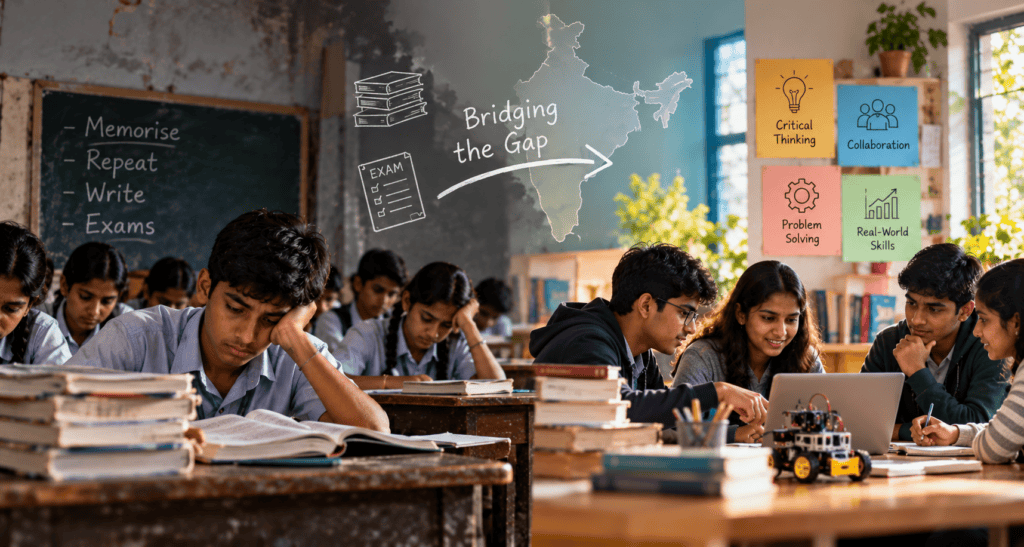
Indian students in contrasting classroom environments, highlighting the gap between traditional rote memorisation and collaborative, skill-based learning.
The deficit is still large. Commentators on ASER 2024 note that India has recovered from some Covid‑era losses. Weak basic reading and math remain the main challenge. Government schools have also long lagged behind schools on learning levels in rural India. With than 100 million children in the foundational stage even small gaps affect enormous numbers of students. The lesson is that India’s problem has moved from building schools to making sure children learn inside them.
So what should be done? First keep reading and math as the top priority with regular simple assessments so teachers can spot struggling children early and give them targeted catch‑up support. Second invest in teachers through classroom training, mentoring and manageable workloads because states have embraced the NEPs teacher‑centric approach and it only works if teachers are equipped to deliver it. Third narrow the gap by directing resources to the weakest districts and tracking learning outcomes alongside infrastructure data. Finally pair these steps with testing beyond the early grades, such, as digital skills, which ASER first measured among 14‑to‑16‑year‑olds in 2024. If India keeps its attention on what children can read do math. Apply the 2020s could become the decade when schooling finally turns into learning.
Sources drawn on: ASER 2024 (ASER Centre/Pratham) and its coverage in Ideas for India, Policy Circle, Vision IAS and UnderstandUPSC. ASER covers rural India only, so check the original report before citing figures formally.