
Not Yet Learning: Fixing the Gap in Indian Education
India has built one of the largest school systems in the world and the numbers on access are impressive.. One sad lesson keeps showing up in the data. Enrolment does not automatically mean learning, which’s why the Annual Status of Education Report (ASER) moved the national conversation from schooling to what children can actually do. The 2020 National Education Policy (NEP) responded by reorganising schooling around a stage: two years of pre‑primary education entry into primary school at age six and basic reading and math by Grade 2 or 3. This is an idea because a child who cannot read fluently by eight struggles with every subject that follows. The latest evidence shows progress. ASER 2024 surveyed 640,000 children in almost 18,000 rural villages and found an overall positive trend in foundational learning with some skills even higher than before the pandemic. The share of Class III children reading at a Class II level rose from 20.5% in 2022 to 27.1% in 2024. Class V reading improved from 42.8% to 48.8%. Government‑school Class III reading rose from 16.4% to 27.9% over the period. Analysts credit much of this to the NEPs focus on reading and math along with state‑level pushes under programmes like NIPUN Bharat. The gains are worth celebrating. These levels start from a low base and ASER covers only rural India. Indian students in contrasting classroom environments, highlighting the gap between traditional rote memorisation and collaborative, skill-based learning. The deficit is still large. Commentators on ASER 2024 note that India has recovered from some Covid‑era losses. Weak basic reading and math remain the main challenge. Government schools have also long lagged behind schools on learning levels in rural India. With than 100 million children in the foundational stage even small gaps affect enormous numbers of students. The lesson is that India’s problem has moved from building schools to making sure children learn inside them. So what should be done? First keep reading and math as the top priority with regular simple assessments so teachers can spot struggling children early and give them targeted catch‑up support. Second invest in teachers through classroom training, mentoring and manageable workloads because states have embraced the NEPs teacher‑centric approach and it only works if teachers are equipped to deliver it. Third narrow the gap by directing resources to the weakest districts and tracking learning outcomes alongside infrastructure data. Finally pair these steps with testing beyond the early grades, such, as digital skills, which ASER first measured among 14‑to‑16‑year‑olds in 2024. If India keeps its attention on what children can read do math. Apply the 2020s could become the decade when schooling finally turns into learning. Sources drawn on: ASER 2024 (ASER Centre/Pratham) and its coverage in Ideas for India, Policy Circle, Vision IAS and UnderstandUPSC. ASER covers rural India only, so check the original report before citing figures formally.
Study Smarter, Not Harder: What Educational Psychology Tells Us About How We Learn
Educational psychology asks a simple question: how does learning happen and what can teachers and students do to make learning better? This field takes ideas from science, motivation research and everyday classroom practice. Often the best ideas go against what we feel is natural. For example re-reading notes and highlighting might seem useful. Research says otherwise. Retrieval practice is an approach. It means pulling information out of memory by quizzing of just reviewing. Studies in classrooms and in labs show that retrieval practice works well. A recent meta-analysis found that retrieval practice helps students in school and high school more than it does for college students. It also shows that quizzes help learning more when they count toward a grade. The practical lesson is clear: testing oneself is one of the effective ways to study learning. Motivation is the part of the story and this is where the field has had a lot of public debate. Growth mindset theory says that students who believe their abilities can change will do better than those who think their abilities are fixed. The idea spread quickly through schools. A more careful look has emerged. A 2023 meta-analysis of 63 studies involving 98,000 students found major problems in how the studies were designed and reported. It also found signs of bias, such as reported effects from authors who had a financial stake in positive results. Another analysis of than 300 studies showed that colorful growth-mindset posters will not solve education’s problems. A popular theory can still be. Good teachers should ask what the evidence really shows. Student using effective study techniques, including memory recall and active learning. It would be a mistake to abandon the idea however. Defenders say that the real claim of growth mindset theory is modest. Schools can help students lean toward a growth mindset often and that can increase motivation and learning for some students. One meta-analysis found that teaching students about how the brain changes as they learn – a concept called neuroplasticity – does tend to build growth mindsets. The mindset of teachers also matters. A meta-analysis of 50 studies covering 19,600 participants found small to typical positive links between teachers’ growth mindset and their motivation in terms of self-efficacy and mastery goals. Together the picture shows real promise, not a miracle cure. The quality of how the idea’s implemented makes most of the difference. For students, teachers and parents the main takeaway is to stay evidence-minded. Use retrieval practice by closing the book and testing oneself. Praise effort and strategy but do not expect a slogan to replace teaching. Treat any study, even a headline-grabbing meta-analysis as just one piece of a larger puzzle. As one commentator notes a single meta-analysis should not end the discussion of a theory that has been studied for than 40 years. Educational psychology is best when it mixes curiosity about how learning works with scepticism about quick fixes. That habit is also good, for learners. Sources drawn on: Psychological Bulletin meta-analysis of growth mindset interventions (2023); Bardach et al., meta-analysis on teachers’ growth mindset (Educational Psychology Review); Learning & the Brain blog posts on mindset research and retrieval practice. Check the original papers before citing them formally.
From Rote to Real: Why STEM Learning Works Best When Students Build Things
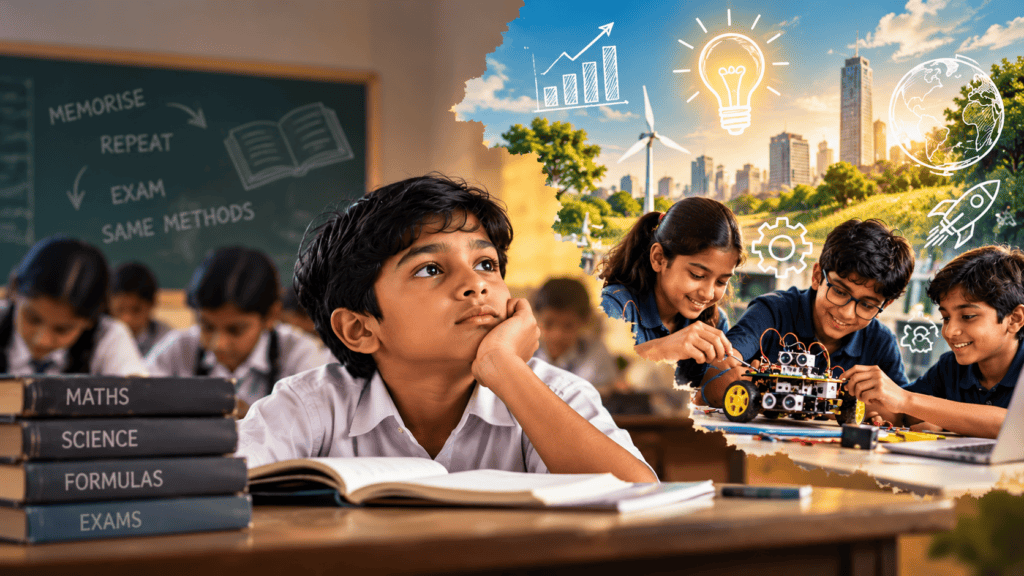
For years science and maths classes have focused on memorising formulas and rules.. The world today values something different. New research shows that traditional teaching often puts much emphasis on rote memorisation. This can leave students feeling disconnected and missing skills like teamwork, creativity and critical thinking. A growing alternative is project-based learning or PBL. In this model students work on real-life projects that’re hands-on and meaningful. These projects help build motivation encourage collaboration and lead to an understanding of the material. STEM is not four subjects taught separately. It is a way of learning where students ask questions test ideas. See why the content actually matters in the real world. The proof of this approach comes from different places and age groups. A 2025 case study of a kindergarten program called “Little Engineers” showed that even young children showed curiosity and worked better in teams when they were doing hands-on STEM projects. At the university level a review of studies from 2019 to 2026 found that project-based learning consistently helped students develop engineering skills solve problems stay motivated and think across subjects. Even small-scale experiments support this. A long-term study of 47 students in Bhutan, where STEM performance has traditionally been low found improvements in how much students identified with STEM and how engaged they were. STEM identity. The belief that “I’m someone who does science”. Is often what keeps students involved in these subjects. Students transitioning from rote memorisation to hands-on STEM learning through robotics projects Hands-on learning is not a perfect fix. The research is honest about its challenges. One study points out that it can be hard to measure what students have really learned. It is also tough to blend subjects and to use digital tools or lab equipment effectively. The Bhutan study also found that student engagement dropped a little by the end of the program. That shows that enthusiasm doesn’t last unless it is nurtured over time. Another review on a platform highlights fairness issues. It found that the benefits were strongest for students who were doing work. They were more likely to gain from project-based learning than students who were struggling or those who were already very strong. The results were also stronger in physics and engineering than in math. This shows that the design of the project matters as much as having one at all. So what should schools parents and students do with all of this? Start small. Make it real. Let one science investigation begin with a question, from a student.. Run a build-and-test challenge.. Have a group project that solves a real problem in the community. Teachers need time, training and good materials to make these projects work.. Assessments must value thinking, teamwork and the process. Not just the final answer. When students stop being observers and become active creators that is when STEM learning truly works. That is the kind of learning the world needs today. Sources drawn on: Northwestern College (Iowa) master’s research on early-childhood PBL (2026); Syzdykova’s review of PBL in undergraduate engineering education (Recent Contributions to Physics, 2025); Education Insights preschool case study (2025); Tshering et al. on STEM identity in Bhutan (2026); AnswerThis summary of PBL in underserved high schools. Check the original papers before citing them formally.